
Course · Media Buying I
5.6) TESTING II
Advanced Meta Media Buying I:
5.6) Meta Ads Testing II

Structure of this module:
- Why testing is the most important thing
- How to come up with testing ideas
Magicbrief introduction (Full Module After) - My testing framework
- Other ways to test
- What metrics to look into, When a winner is a winner? When a winner is a scalable winner
- Testing as a weekly habit
- How to track your previous tests and stay organized?
3) My testing framework
Now let’s see how to bring all of this into the ads manager.
Make sure you follow your specific ad account structure, based on your business.
There are 2 types of testing we must distinguish.
Testing type 1: Figure out something from scratch.
Testing type 2: Checking if the new ads we have created based on a previous winning ad, perform good or bad.
-----
When I take over a new ad account, there are 7 variables that I want to test, isolated.
Isolated means NO CBO, no mixing ads, no letting Meta optimize for me.
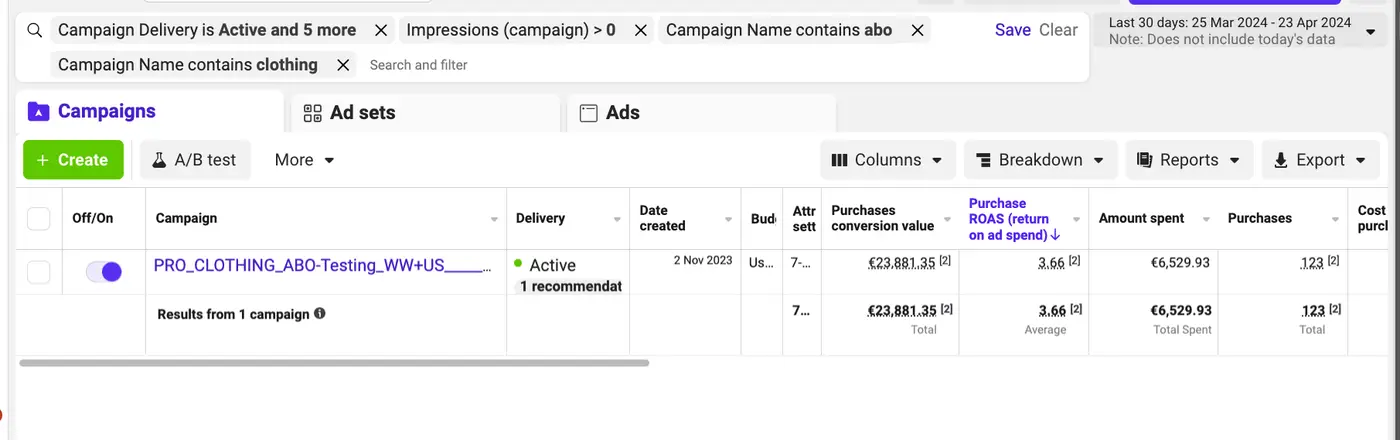
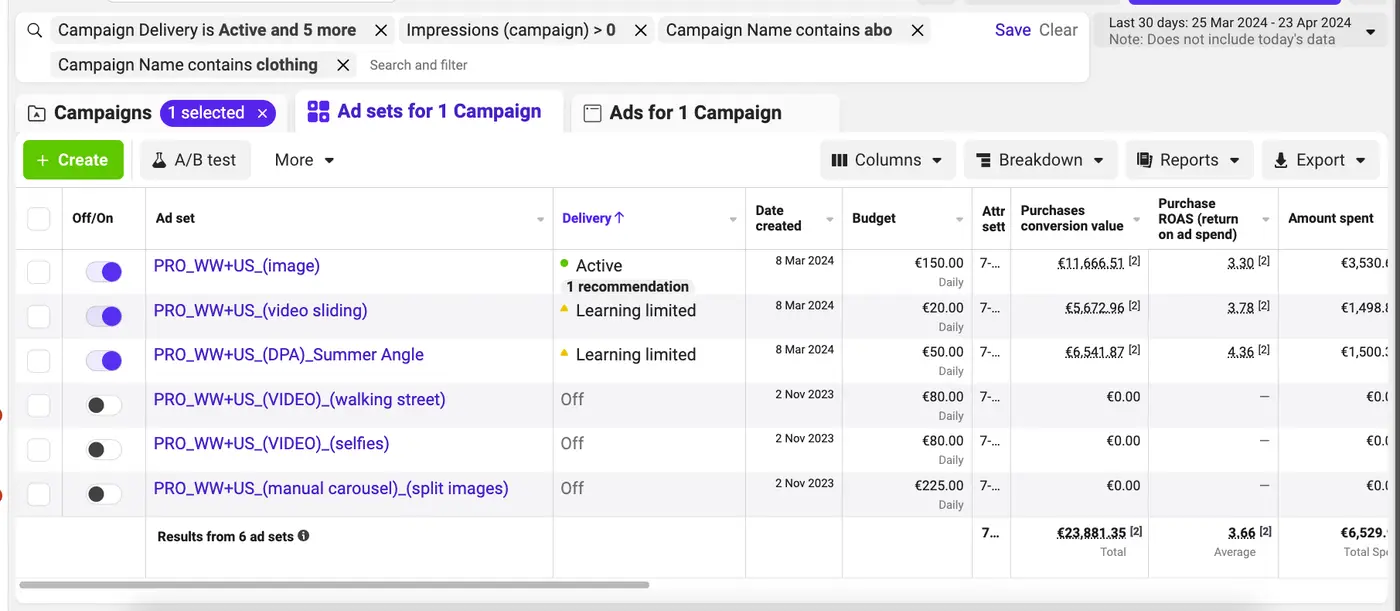
So for this, I use “ABO 1 ad per ad set” format.
This is the most pure form of A/B testing.
In this case, I’m not looking for Meta’s algorithm to optimize and decide who’s best, who's worst etc…
I just want the same budget to go to each variable, every day, for 4-7 days, and then extract a conclusion.
Fast and simple.
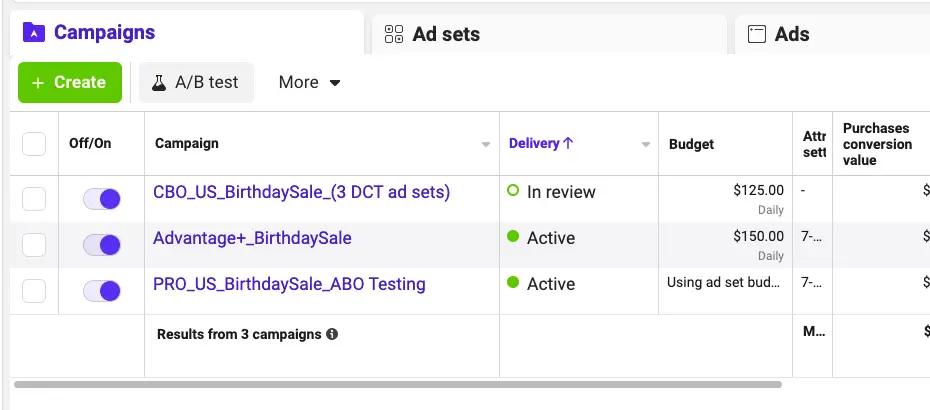
It looks like this in the campaign level:
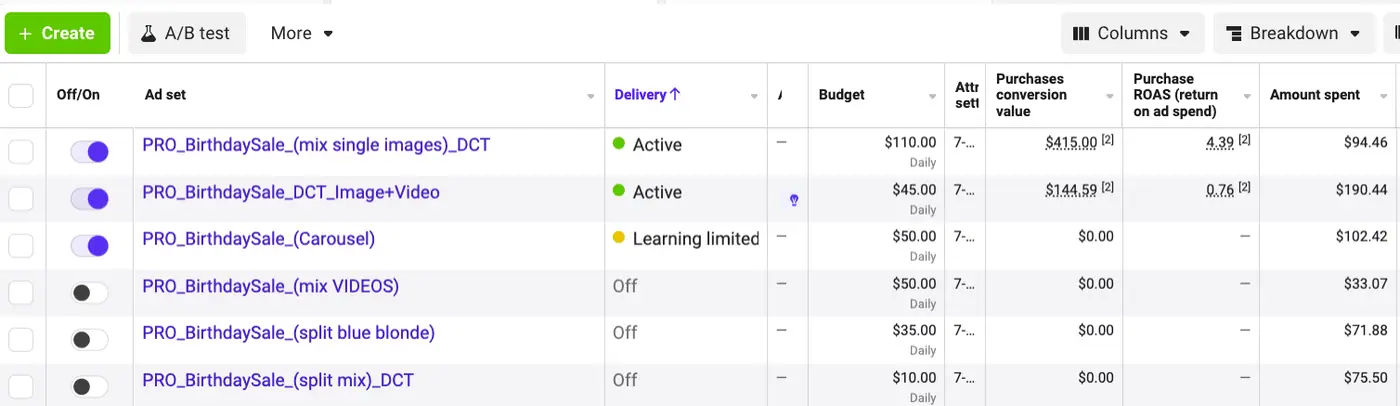
And it looks like this in the ad set level:
__
Testing type 2: Checking if the new ads we have created based on a previous winning ad, perform good or bad.
This opens more options.
I’ll give you an example first, and then the theory behind it.
(Explained later below, this is just a teaser)
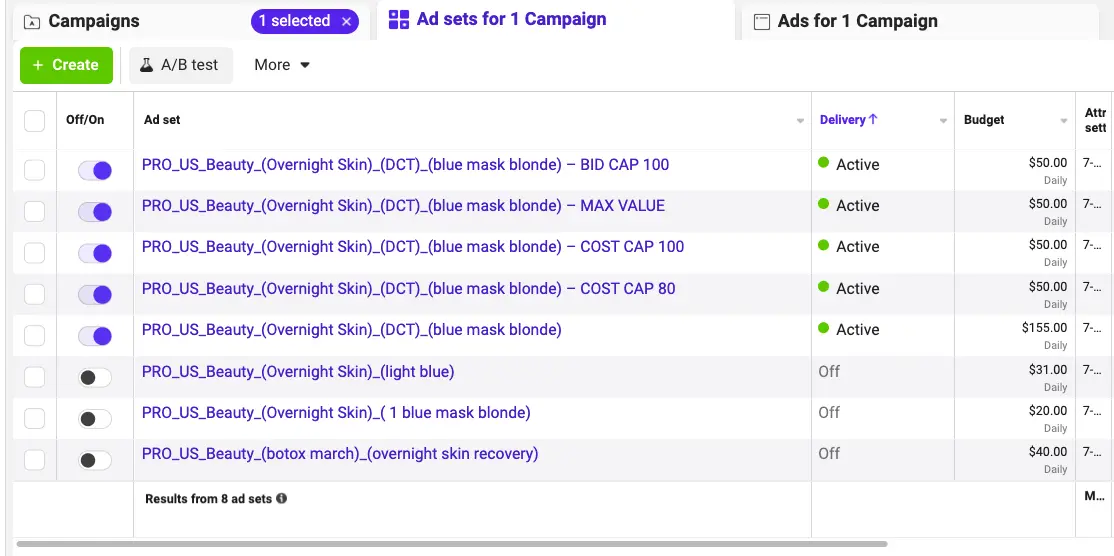
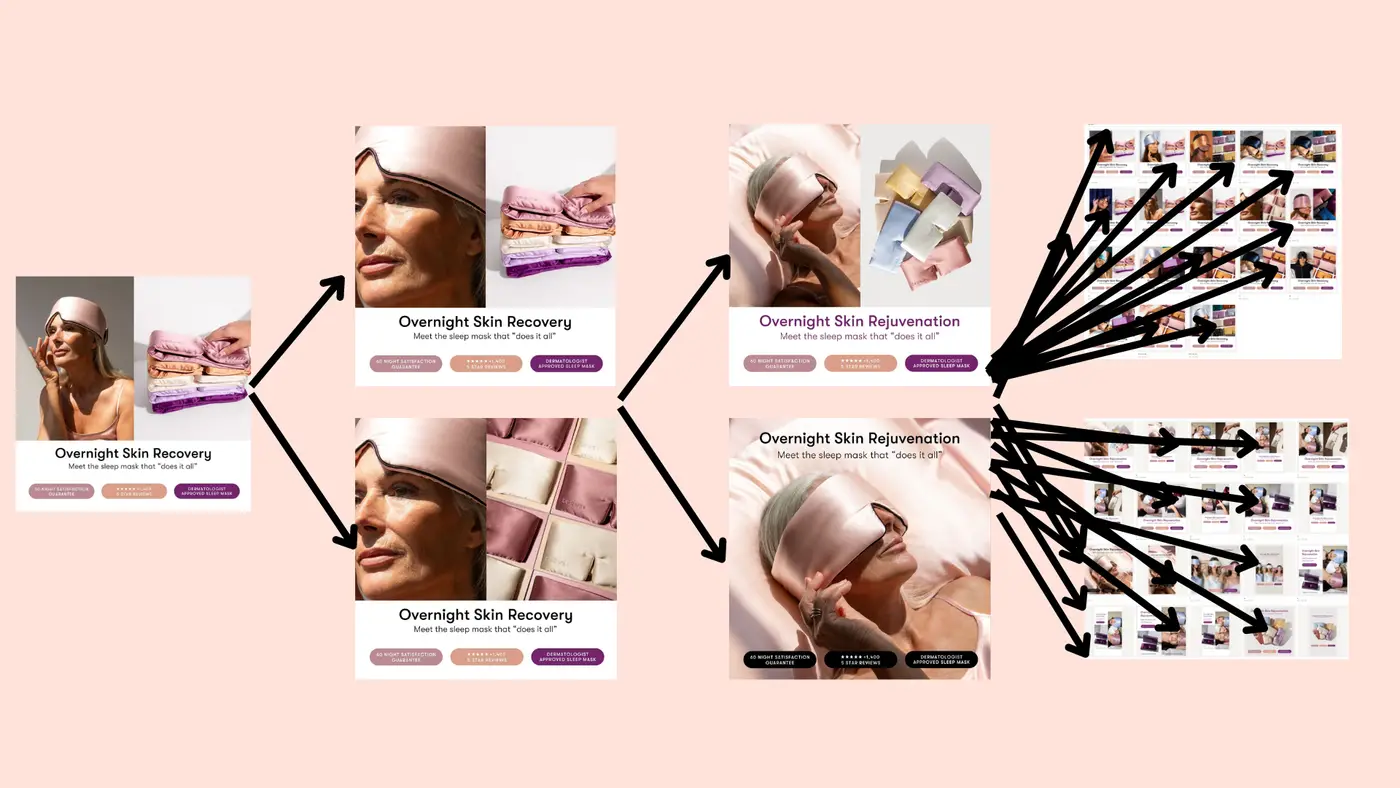
In step 1, “ABO 1APA” was very important to discover that the overnight skin recovery angle was the best.
Then I got 2 new winning ads with “ABO 1APA”.
But in step 4, I received like 30 new ads.
They all have 3 things in common:
- Winning angle “overnight skin recovery”
- Image ads
- Split screen format
And these 3 things in common, have been proven to work.
If I receive 30 new ads, do I need to create 30 new ad sets, following the 1APA rule?
No. Because you’re NOT testing from scratch, you’re scaling a winning combination.
So we have to put the 30 ads together in 1 ad set?
No. Neither. You have to group the 30 ads into categories.
Ad set categories could be things like: having an old woman versus a young woman in the image, or having one type of product image on the right versus another type, or having images where the model is sleeping versus images where the model is looking at the camera.
You see, we are now grouping. We are not as detailed as in the “testing from scratch” type.
How to launch this into the ads manager?
- ABO
- Either use ABO with 3-5 ads per ad set,
- or use “dynamic creative testing” with 3-10 ads
(What is Dynamic Creative Testing?)
- Overnight skin recovery
- Blue mask versus light blue (in isolation 1APA)
Blue mask wins - Then we make a lot of variations for the blue mask ad
(Change the model, change the headline, change the product image, change the color, …) - DCT blue mask with 10 ads
And it works great - DCT blue mask with 10 ads + Manual Bidding x4
Another example:
I receive these 24 ads (12 real ads, because we have 2 formats for each ad).
I am NOT going to test the 12 ads separately.
I do 3 ad sets with DCT.
Ad set 1: single images, DCT, 4 ads (8)
Ad set 2: split screen images, DCT, 6 ads (12)
Ad set 3: blue blonde mask, just 1 ad, no DCT because this is our all time winner
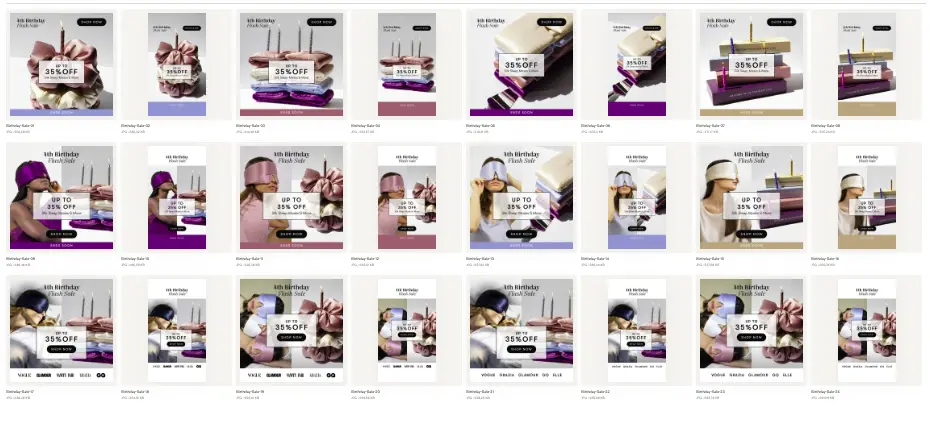
And this is how it looks like:
_________________________________________________
In my testing framework, I test based on goals and problems.
In the troubleshooting module, we will see this in detail, but to give you an early idea on testing to solve problems:
When the CTR is low:
- Test more creatives
- Especially test new angles
When the CPM is high:
- Test more creatives (if Meta sees early good reaction from their users, they will lower your CPM)
- (there are more ways, talk about it later)...
When the conversion rate is low and the cost per add to cart is high (similar for low AOV):
- Test new offers
- Test new landing pages
It is important that you understand that for troubleshooting, I’m NOT looking at the ROAS, but I’m looking at the metrics that finally influence the ROAS: CPC, AOV and Conversion Rate.
4) Other ways to test
CBO
CBO is not my go-to strategy for testing.
But many people use it to save time and to rely on Meta’s ability to find the right ad creative.
Structure example with 5 ad creatives:
- 1 campaign CBO
- 5 ad sets, 1 for each creative
- 50-120€/day in budget
What you can do in the first 3 days is force the budget to be divided equally across ad sets.
If you have 5 ad sets, you can put a rule that each ad set receives 20% of the total budget.
Or if you want to give Meta a bit of freedom but also have some type of control, you can force each ad set to receive 10% of the budget every day (10%*5 = 50%) and then let Meta decide where the other 50% will go.
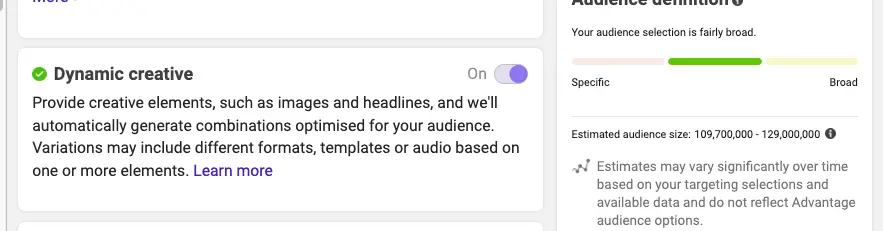
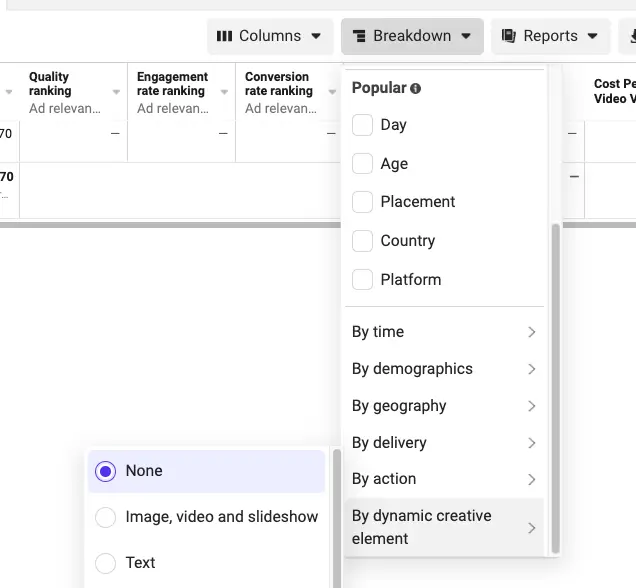
Testing Directly DCT
As I said before, when I have NEW things to test, I don’t do DCT. I do ABO 1APA. And when I scale things or expand creative ideas that have worked, I sometimes use DCT.
You can try direct DCT for testing new ads.
Meta will decide where the budget goes.
Supposedly, bad ad creatives won’t receive budget while good ad creatives will get it all.
5) What metrics to look into, When a winner is a winner? When a winner is a scalable winner?
Metrics to look into:
- Traffic metrics
- Conversion metrics
Traffic metrics: CTR, CPM, CPC
Conversion metrics: ROAS, Cost per Purchase, CATC
Of course the number 1 metric is ROAS.
But ROAS depends on TOO MANY factors like, the random audience the ad was delivered to, the time of day, if they clicked with wifi or mobile data, if the website loaded quickly, if the landing page conversion rate is high, if the color they like is in stock, etc etc etc.
But traffic metrics don’t lie.
A click is an initial sign of interest.
A high CTR tells us that the ad is very good at generating clicks. This is very important, because at scale, CPC will usually go UP and we need low cost of traffic to scale profitably.
What I’m trying to say is that:
Ad 1, ROAS 2.5, 5 sales, CTR 2%
Ad 2, ROAS 3.8, 7 sales, CTR 0.9%
I’m picking ad 1 all the way !! Because it will mature much better. A difference of just 2 sales is random, it’s luck. But the CTR doesn’t lie!
When is a winner ad a winner ad?
At least 5 purchases or 100€ in ad spend. One of the two.
And that would be an “early stage winner ad”.
A matured winner ad requires:
- 10 purchases or more
- ROAS equal or above your target ROAS
- 200€ in ad spend or more
- Engagement in the ad (likes, comments, …)
- (optional) CTR higher than your ad account average
- (optional) CPM lower than your ad account average
- (optional) Out of the learning phase
Conclusion: there’s no one definition of a winning ad. We have early winners and matured winners. They are different.
When a winner ad is a scalable winner ad?
When it has matured.
When the ad is an early stage winner, it doesn’t guarantee you will be able to scale it.
We’ll see more about scaling winning ads horizontally and vertically in the scaling module.
Testing as a weekly habit
Remember from the hyperscaling mindset module:
“MINDSET 3: Become a Testing Paranoid”

Testing must become a weekly habit.
When you take inspiration from competitors and you take inspiration from your own learnings in your testing campaigns, the amount of creatives you can do is unlimited.
Again, remember scaling comes from testing, the more you test, the better you scale.
How to track your previous tests and stay organized?
EXPLAIN