
Course · Media Buying II
6.7) Advanced Scaling Strategy
Advanced Meta Media Buying II:
6.7) Advanced Scaling Strategy

Structure of this module:
- The most important rule and mindset
- Vertical Scaling: Daily Increases + Intraday Scaling
- Horizontal Scaling: Growth by Duplication
- Maximizing Efficiency: Learning Phase and Consolidation
1) The most important rule and mindset
“If a man knows not which port he sails, no wind is favorable.” - Seneca.
- You need a clear goal and direction to scale on Meta
- How much do you want to spend every day?
500? 1k? 3.5k? 10k? What’s the exact goal?
- *remember now the mindset exercise from the first module (print the photo!!)
This is important for two reasons:
First, when you have a goal, you have a sense of direction. You will come to the weekly sessions asking specific questions. You will look for people who are spending that number already. You will be proactive.
And second, if your goal is to spend 2k per day profitably, and right now you are spending 700 per day, you have a problem. And that problem needs a solution, so this exercise puts you into a very powerful “problem-solving mindset”.
Just answer this question: What’s your daily ad spend goal?
Let’s keep going.
2) Vertical Scaling: Daily Increases + Intraday Scaling
Vertical Scaling Strategy #1:
- Scale your daily budget in your winning ad sets and campaigns
- 20-50% increases depending on KPI deviation
High deviation scenario:
KPI: ROAS 3
Last 3 days data: daily budget 50€, total spend 150€, ROAS 5, revenue 750€
Daily budget increase: 50 → 75€ (+50%)
Low deviation scenario:
KPI: ROAS 3
Last 3 days data: daily budget 50€, total spend 150€, ROAS 3.2, revenue 480€
Budget increase: 50 → 57€ (+14%) - Time range to make a vertical scaling decision:
Time range in the ads manager: → last 2 days + today
As I said in the optimization module, before making a scaling decision, I check 2 things: ‘last 2 days + today’, and then I also check ‘yesterday’. This way I see the trend. Never check today alone. - Frequency of scaling:
If your ROAS is amazing (high deviation) then you can scale every 24-48h by 30-50%.
If your ROAS is not bad but not amazing (low deviation) then you should scale 48-72h by 10-30%.
If you spend >1k per day, optimize daily.
If you spend <1k per day, optimize daily if ROAS is amazing and if ROAS is VERY bad.
If you spend <1k per day, optimize every 2 days if ROAS is average, not good not bad.
Example
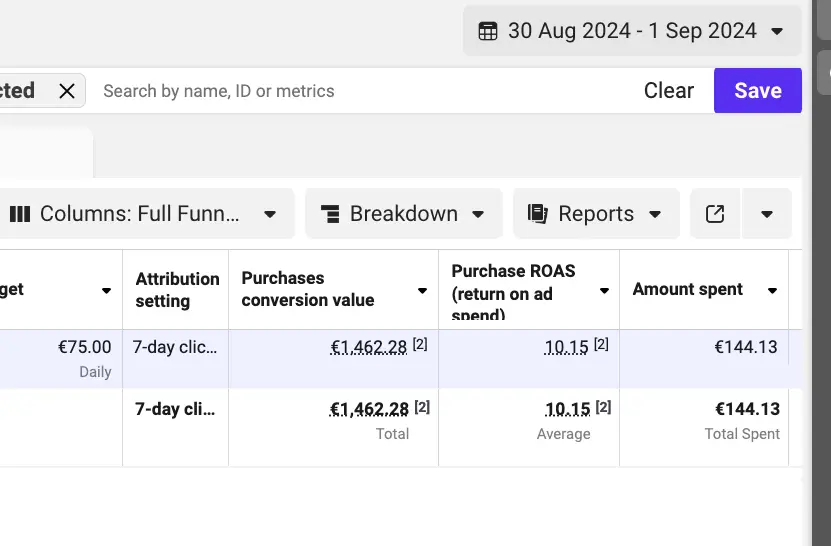
- Target ROAS: 4.5
- Launch budget: 50€
- ABO
- I check the last 2 days + today, and I realize I’m in a high deviation scenario. I’m underspending !!
- Vertical Scaling on September 1st: 50€ -> 75€ (+50%)
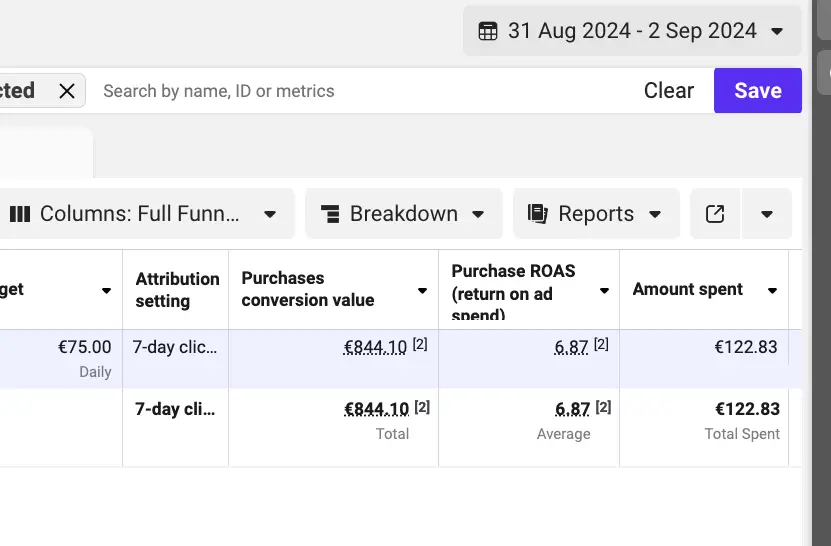
- The ROAS on the “last 2 days + yesterday” used to be 10 but after scaling it has gone down to 6, something bad is happening, let’s check yesterday
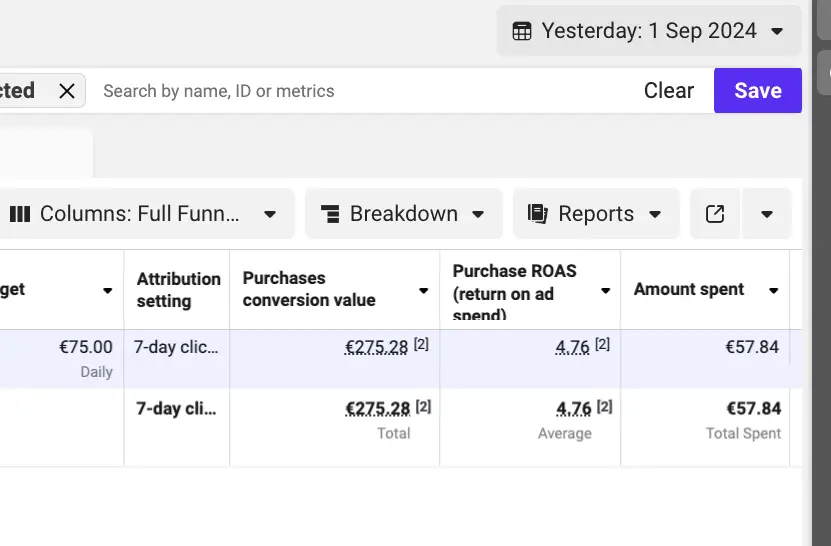
- If my target ROAS is 4.5 and yesterday I did 4.76, should I continue to scale? No. The ROAS trend is going down.
- I relax for 1 more day and will make a decision based on the results I see today and tomorrow.
This does NOT annoy me because in this account, if an ad set cannot sustain a small budget of 75€, I’m not interested in that ad set, I just kill it.
When the ad set ROAS gets broken by a small budget of 75€/day, it just indicates to me that it was not a real winner, not a candidate for my big scaling plans.
Intra-Day Vertical Scaling
This is wave surfing in evergreen campaigns.
You want to maximize your ad spend during a specific wave.
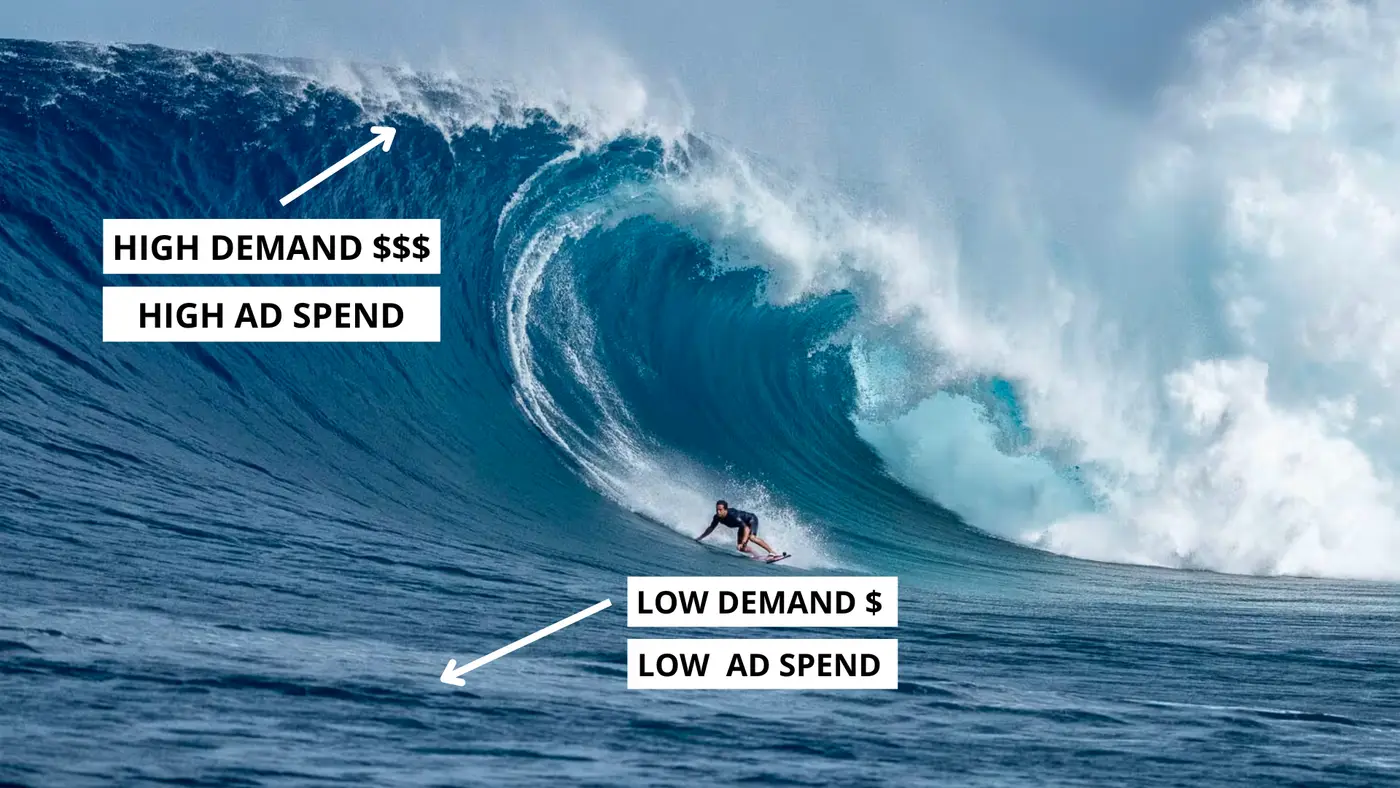
This is relevant for “Weekly Waves” and “Daily Waves”.
For example,
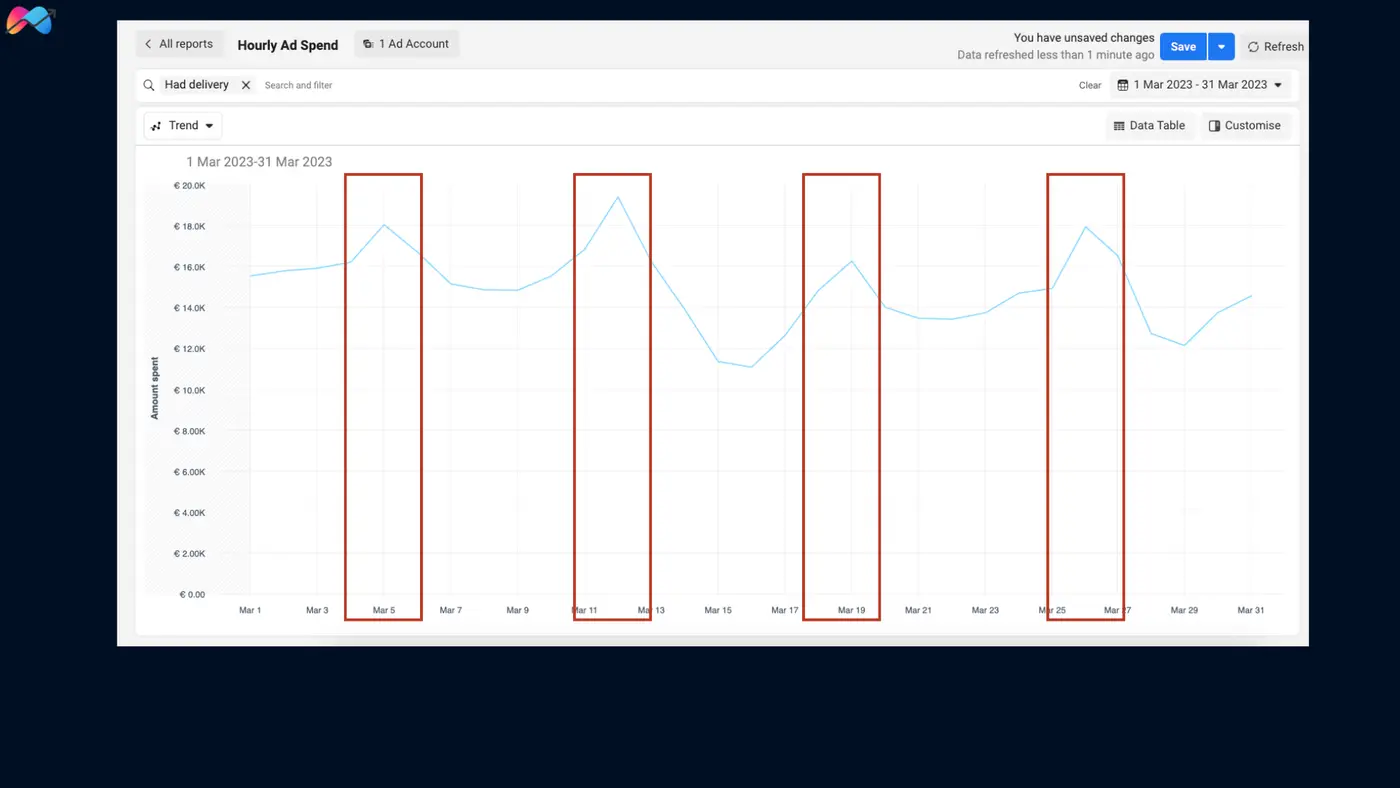
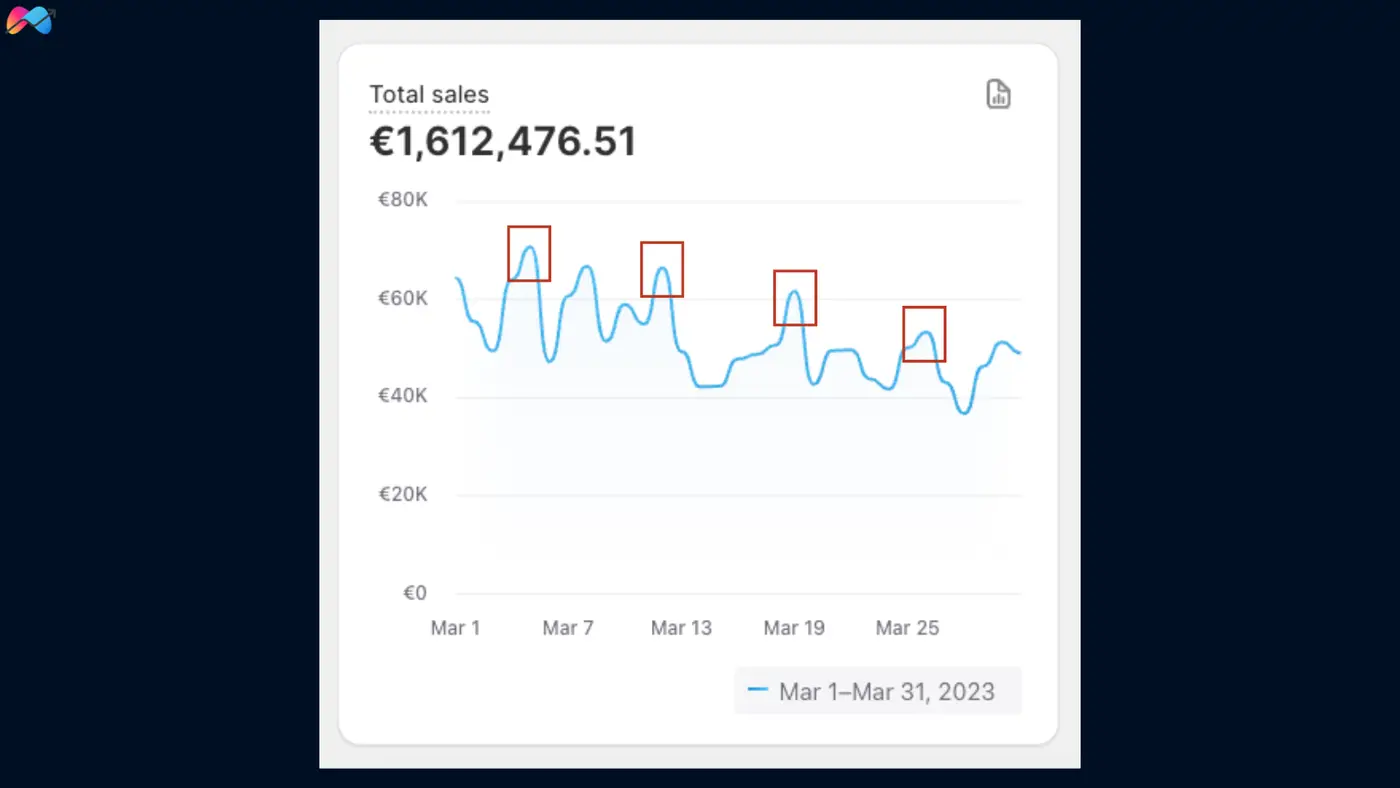
In the case above,
- On Thursday I spend €14k
- On Sunday I spend €19k
- But on Monday I’m back to €15-16k
That’s because of my weekly wave:
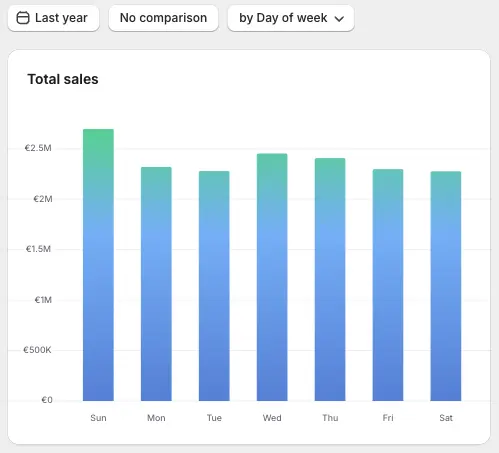
- Sunday is the top day in 2022 and 2023
- So in 2024 I just follow this pattern and I do intraday scaling every Sunday
And I go as specific as doing it in a specific hour window.
My daily wave.
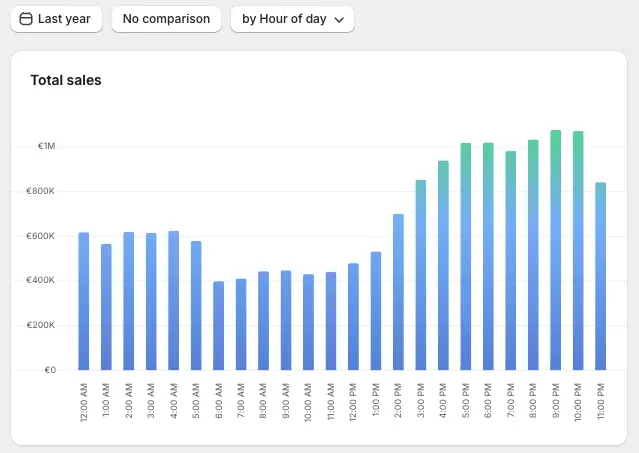
- Daily Wave: 4pm-10pm
Intraday scaling actions:
- Budget increases of 100-500% in my best performing scaling campaigns during 6 hours
- This is NOT risky, because you DON’T increase your daily ad spend by 500%, only the proportional of 500% during 6 hours
Example of calculated intraday scaling:
Typical day:
- Scaling campaign 1: 500€
- Scaling campaign 2: 750€
- Total daily spend: 1,250€
Sunday 4pm (+300% for 6 hours):
How much does the total budget of the whole day increase? Not by 300%, because 300% is only for 6h.
- Scaling campaign 1: 1,500€
- Scaling campaign 2: 2,250€
- “Total daily spend”: 3,750€
- Hourly spend after the increase: 3750/24= 157€/h
- Hourly spend before the increase: 1250/24= 52€/h
- Daily spend for 18h (normal): 18*52 = 936€
- Daily spend for 6h (+300%): 6*157 = 942€
- Real total daily ad spend = 1,878€
- So the ad spend only changes by 1878-1250: 628€ but those extra 628€ are very intentional and happened during the best day of the week and the best hours of the day.
3) Horizontal Scaling: Growth by Duplication
In a perfect world, vertical scaling would be enough.
We find a winning ad set, we scale the budget 30% every day, we automate that and we go to 10,000€ in daily ad spend.
But the world is not perfect.
And we still need to spend 10,000€ per day.
So, let’s cover horizontal scaling.
Horizontal scaling = Diversification.

Horizontal Scaling Options when you find a winning ad set inside your testing campaigns
- Just duplicate the ad set (not recommended)
- Duplicate the ad set and make a small change to the ad creative (change headline, change person, change color)
- Duplicate the ad set and change the ad copy
- Duplicate the ad set and change the audience
(targeting, location, gender, age) - Duplicate the ad set and change the URL
- Duplicate the ad set and add your winning Cost Cap
- Duplicate the ad set and add your winning Bid Cap
- Duplicate the ad set and add your winning Max Value
- Duplicate the ad set into an Advantage+ Shopping Campaign with and/or without manual bidding
- Duplicate the ad set into a CBO campaign with and/or without manual bidding
Which ones do I use the most in 2024? (In this order)
- Duplicate the ad set and add your winning Cost Cap
- Duplicate the ad set and add your winning Bid Cap
- Duplicate the ad set and make a small change to the ad creative
- Duplicate the ad set into an Advantage+ Shopping Campaign with and/or without manual bidding
- Duplicate the ad set into a CBO campaign with and/or without manual bidding
- Duplicate the ad set and change the URL (cvr,aov)
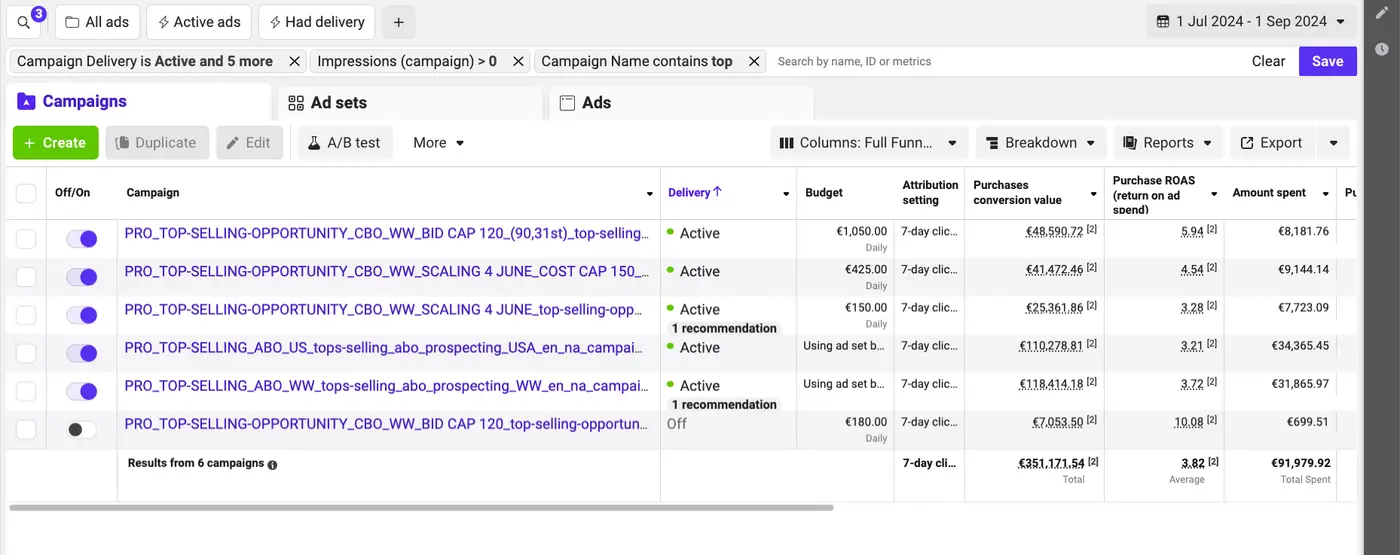
- I have two ABO testing campaigns (one WW and one USA)
I scale the winning ad sets vertically
And I do ABO horizontal scaling adding new ad sets with manual bids
- Then I select the best ad sets and create the scaling campaigns
Mostly CBOs with manual bids - Once I have this set up, I can relax a little bit with horizontal scaling and focus on “day trading”, which means, managing budget, optimizing daily and just focusing on vertically scaling my set up
- When some of my scaling campaigns die, I can make an analysis (for example CC vs BC) and launch new improved versions
- Also when those scaling campaigns are “full of ads”, I will create new ones to not waste those winning ads “approx. every 5 winner ads, new CBO”
Another example (Horizontal scaling into scaling campaigns)
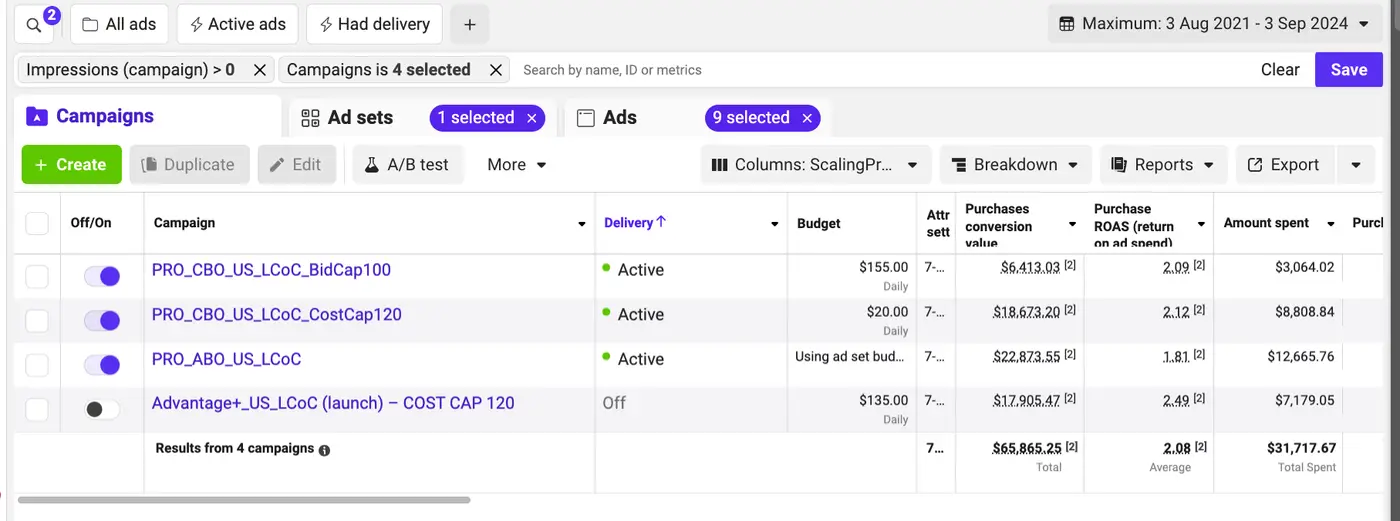
- Specific product launch for 1.5 months
- Target ROAS at scale: 2
- The ABO campaign is purely testing, 1 ad per ad set
This ABO campaign can scale vertically - And then I scale horizontally into Adv+ and CBO campaigns
Another Example (ABO horizontal scaling):
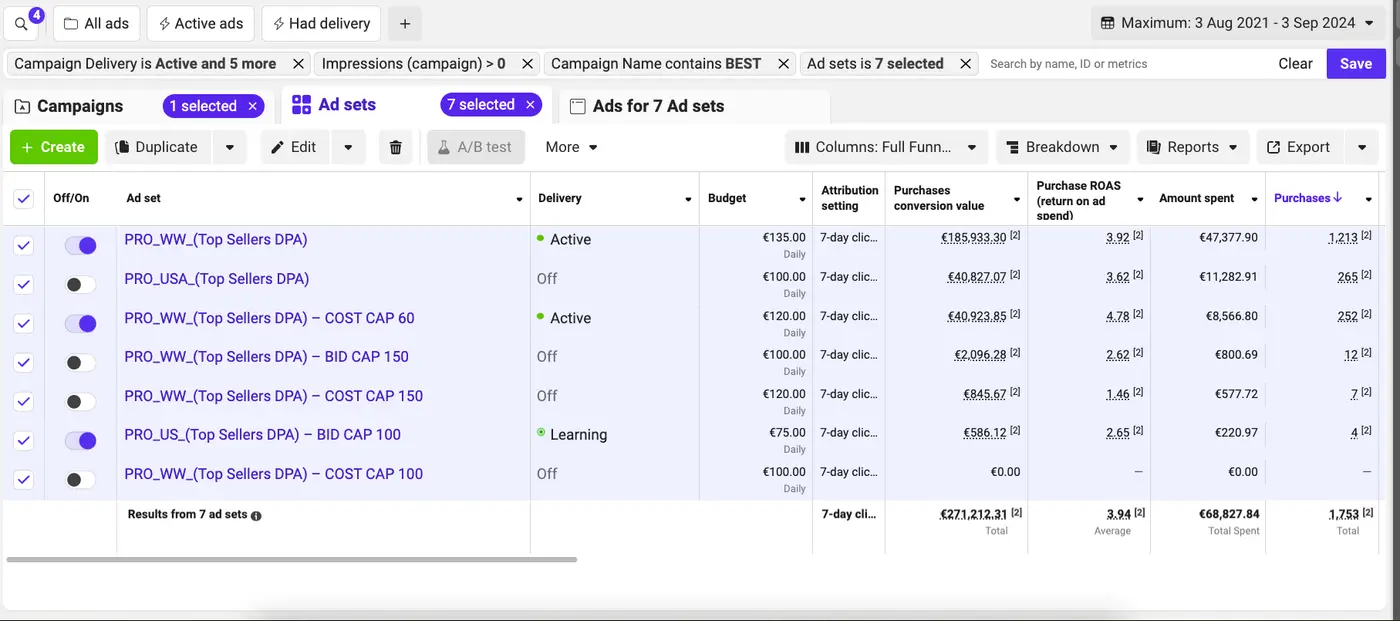
- If I only stick to my initial winner “PRO_WW_(Top Sellers DPA)” then I would have missed out on (271-185) €86,000.
- Again, vertical scaling has limitations, as you start increasing your budget, the ROAS will go down and you have to get creative with horizontal scaling, what did I do in this example:
- Duplicate and change country (US only)
- Duplicate and add an overbidding Cost Cap (100 and 150)
- Duplicate and add an underbidding Cost Cap (60)
- Duplicate and add an overbidding Bid Cap (100 and 150)
Another Example (ABO horizontal scaling):
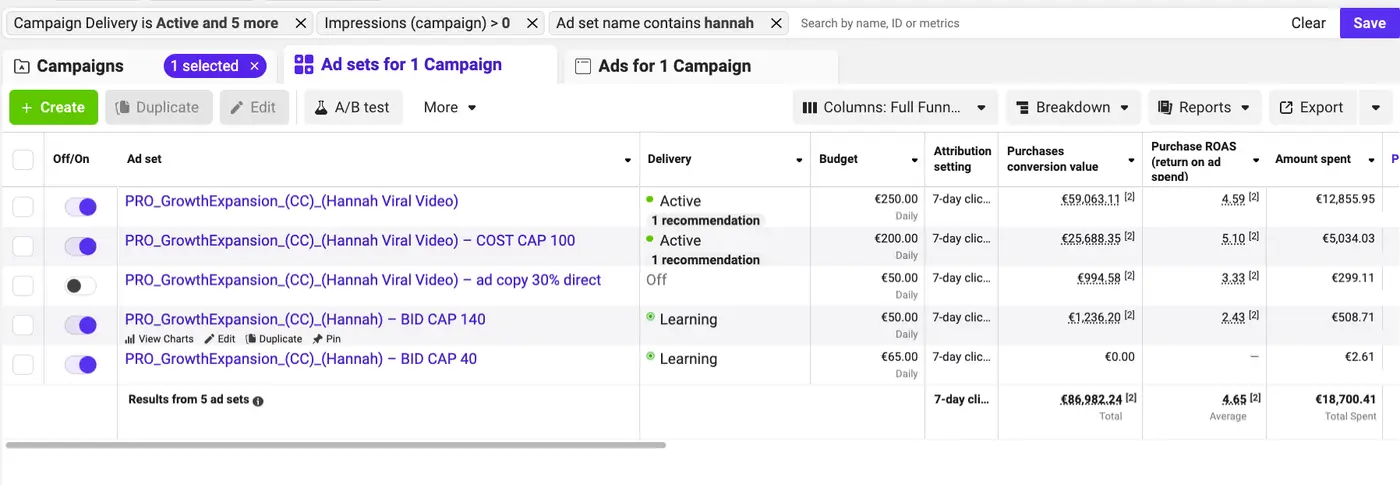
- I find a winning ad set “Hannah Viral Video”
- I’ve been able to spend €12k on this ad set alone, but usually when I pass the €300 daily budget, my ROAS suffers, so I have to get creative, this I did in this example:
- Duplicate and change the ad copy
- Duplicate and add an overbidding Cost Cap (100)
- Duplicate and add an overbidding Bid Cap (140)
- Duplicate and add an underbidding Bid Cap (40)
- Learnings?
- “Hannah” is a winning ad
- Cost Cap 100 works phenomenal
- Possible next steps?
- Go from ABO to a “Consolidated Scaling Campaign”
- Which means, either Advantage+ or CBO
- And this needs at least 3 winning ads, cannot do it with “Hannah” alone
- So I will take 3 winning ads from this product and create:
- For example: “CBO_(CC)_(3 winners)_CostCap100”
All in all, why this set up minimizes risk and inconsistency
- Diversification
- Automatic bidding, manual bidding
- ABO, CBO
- Therefore → Different budgets for different performances
- This gives you OPTIONS
Extra Horizontal Scaling
- Opening a secondary ad account
- Using a new fanpage
The example I’ve seen with many cosmetics brands is where they create a new fanpage with the name of a “magazine”. They use this new fanpage to run “neutral” ads to a listicle or advertorial, and eventually bring people to their Shopify checkout.
Random example:
- LART Cosmetics
- The Beauty Post (fake magazine, fanpage)
https://thebeautypost.com holds an “article” where they compare the top 5 products for fighting acne in women aged 30+.
This article is crafted for conversion and ends up selling the product of LART cosmetics with an amazing urgent offer.
When you click on “Shop Now” it takes you either to LART product page or straight to their checkout.
This would also be considered horizontal scaling.
4) Maximizing Efficiency: Learning Phase and Consolidation
*Only implement these rules and actions once you have reached a “daily budget limitation” or once it is annoying to have so many scaling campaigns.
The Logic of Consolidating to Maximize Efficiency
As you know, my scaling campaigns usually have more than 3 winning ads but less than 7.
This means that approximately, every 5 winning ads I create a new scaling campaign.
If it gets to a point that you have 10 scaling campaigns spending 1,500€ per day in total (for example), this would be a PROBLEM.
Why? Because 10 scaling campaigns at 150€ each one is INEFFICIENT.
Meta = Machine Learning. The more data you give to an ad set, the better the performance.
In that case, after you reach 10 scaling campaigns (no rigid number, it’s an example) you would need to start thinking about consolidating.
Consolidating = Merging scaling campaigns and going from 10 to 5, and going from 150€ in ad spend per day per campaign, to 300€ per day per campaign.
In the consolidation phase, we DO NOT CARE that one winning ad is not receiving ad spend. (we put 10 ads per campaign, and if only 2 spend money, i don't care)
For example, we have 10 ads per scaling campaign, at this stage I DO NOT CARE that 8 ads don’t get ad spend.
In summary,
Consolidating to maximize efficiency means having less campaigns and more budget per campaign.